| .. | ||
| detailed.mmd | ||
| detailed.png | ||
| flow.mmd | ||
| flow.png | ||
| README.md | ||
| simple.mmd | ||
| simple.png | ||



Webatrice architecture diagrams
Three views of the same architecture at different zoom levels. The .mmd files are the source of truth — edit them and re-render when the architecture changes. The .png files are committed so the README and GitHub file view render everywhere, including offline.
For the prose counterpart and conventions, see ../.github/instructions/webclient.instructions.md (the canonical AI-tool instruction surface for this package).
When to look at which
| Diagram | Use it when |
|---|---|
| simple | You need a mental model of the request/response loop in ten seconds. Good for onboarding. |
| detailed | You're making a structural change and want to see every module, which layer it belongs to, and how data moves between them. |
| flow | You're debugging a specific round-trip and need to see the runtime order. Shows the cmdId-correlated response path vs. the extension-dispatched event path, plus the "no timeout, no retry" caveat. |
Simple — high-level flow
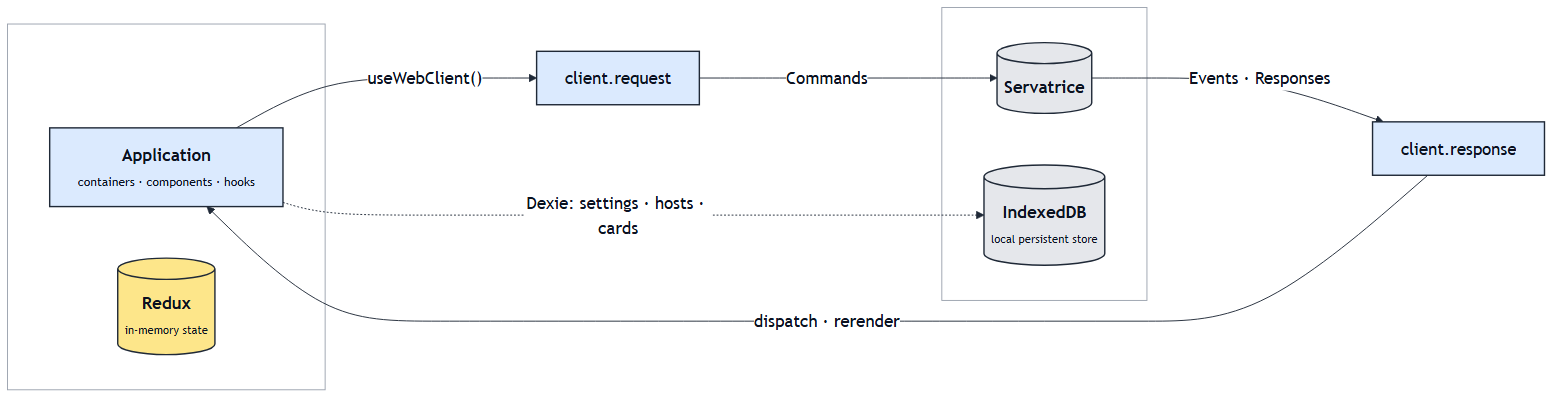
Application on the left, Servatrice on the right, two-lane racetrack in between. The top lane is outbound (client.request.* → Commands), the bottom lane is inbound (Events · Responses → client.response.*), and both lanes ride the same WebSocket. Redux hangs off Application as its in-memory store; IndexedDB sits under Servatrice as the browser-side persistent store reached from hooks via Dexie. Both are stores, both sit outside the racetrack.
Color = role:
- Blue — application code (UI, hooks, API seams, WebClient)
- Purple — transport (WebSocket layer, services)
- Amber — state / data stores (Redux, protocol types)
- Gray — external systems (Servatrice, IndexedDB)
Detailed — layers & dependencies
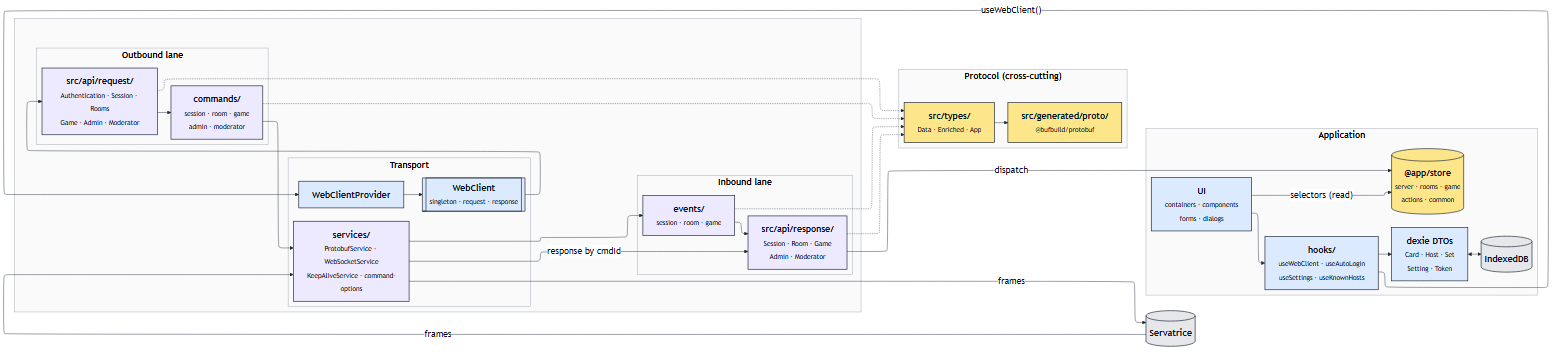
Every meaningful module in the webclient, arranged as a three-lane racetrack: outbound (src/api/request/ → commands/) on top, transport (WebClientProvider → WebClient → services/) in the middle, inbound (events/ → src/api/response/) on the bottom. Application bookend on the left holds UI, hooks, Redux store, and the Dexie persistence pair; Servatrice sits on the right. The protocol satellite (src/types/ + src/generated/proto/) is drawn below with dashed edges up to the modules it types — it's cross-cutting, not on the flow path. Same four-role palette as the simple diagram.
Load-bearing invariants (enforced on webclient-websocket-layer; keep it that way):
- UI never imports
@app/websocketor@app/api— always go throughuseWebClient(). - Only
src/types/imports from@app/generated— everywhere else usesData/Enriched/App. - Only
*.dispatch.tshelpers and*ResponseImplclasses callstore.dispatch— the API response layer is the single inbound seam into Redux.
Flow — command → response → event round-trip
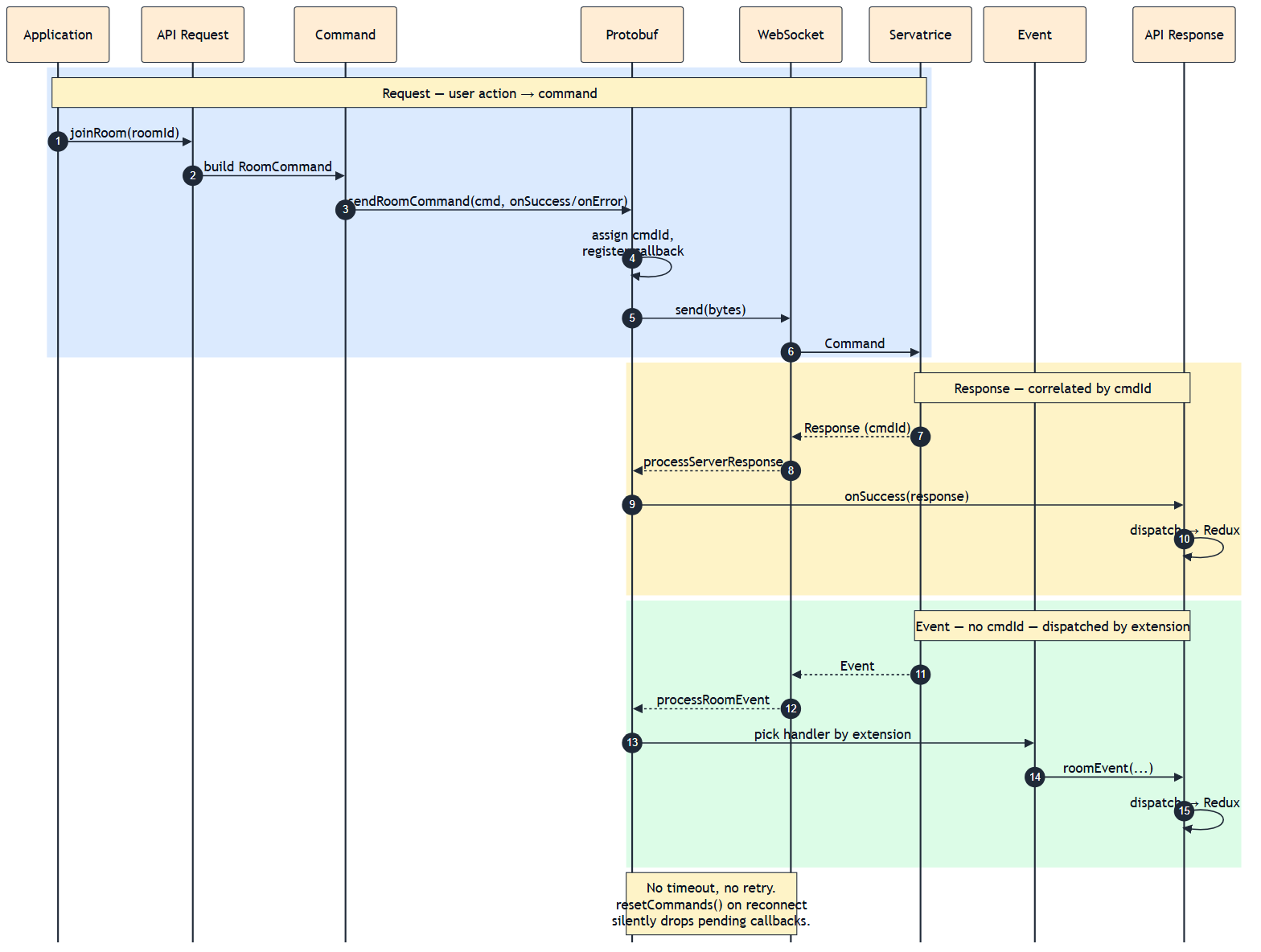
Scenario: user joins a room. The sequence shows the outbound command path (steps 1–6), the correlated response path matched by cmdId in ProtobufService's pending map (steps 7–10), and an unsolicited server event dispatched by proto-extension match against the event registry in processRoomEvent / processSessionEvent / processGameEvent (steps 11–15).
Read the footnote: ProtobufService has no timeout and no retry, and resetCommands() on reconnect silently drops in-flight callbacks. Code that needs reconnection resilience has to handle it at a higher layer.
Rendering
npm scripts are defined in ../package.json — no separate build step, no added runtime dependency (everything runs via npx).
# from the webclient/ directory:

npm run diagram            # render all three (simple + detailed + flow)
npm run diagram:simple     # render just simple.png
npm run diagram:detailed   # render just detailed.png
npm run diagram:flow       # render just flow.png
Under the hood each command is:
npx -y -p @mermaid-js/mermaid-cli -p puppeteer mmdc \
    -i architecture/<name>.mmd -o architecture/<name>.png -b white -s 2
-s 2 renders at 2× scale so the PNG stays crisp on high-DPI displays; -b white gives the diagrams a light-mode background that looks right in both GitHub's light and dark themes.
If mmdc fails locally (it spawns headless Chromium — some sandboxed environments block that), paste the .mmd contents into mermaid.live and export to PNG. The .mmd sources remain canonical either way.